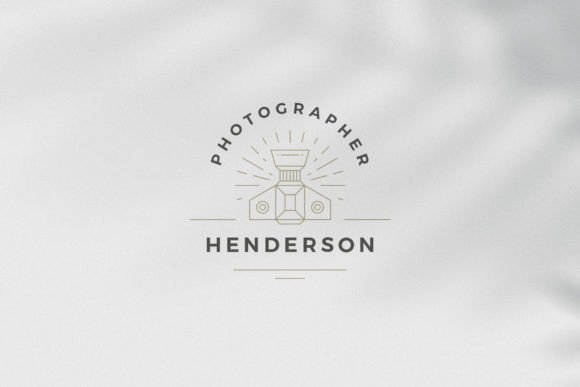
Photographer Line Art Minimal Logo: A Strategic Evaluation for Creative Branding
In the contemporary visual landscape, particularly within the creative industries, the distinction between a brand and its identity often hinges on subtlety. The Photographer Line Art Minimal Logo represents a specific design philosophy that prioritizes clarity, scalability, and professional elegance over ornate complexity. For professionals ranging from freelance photographers to beauty salon owners, selecting a logo template is not merely an aesthetic choice but a strategic business decision. This evaluation explores the utility, versatility, and technical specifications of minimalist line art logos, helping stakeholders determine if this approach aligns with their branding objectives.
The Anatomy of Minimalist Line Art Design
At its core, the Photographer Line Art Minimal Logo relies on the principle of reduction. By stripping away non-essential elements, designers isolate the most recognizable symbols associated with a profession. In the context of photography, this often manifests as abstract representations of camera lenses, apertures, or human hands holding equipment. The use of continuous lines creates a sense of flow and sophistication, suggesting precision and attention to detail—qualities highly valued by clients in high-end service sectors.
Unlike illustrative or mascot-based logos, line art designs are inherently modern. They avoid the dated appearance that can plague complex vector graphics, ensuring that the brand remains relevant as design trends evolve. The "minimalist" aspect does not imply simplicity in execution; rather, it demands rigorous editing to ensure every stroke serves a purpose. This results in a visual identity that is clean, memorable, and easily reproducible across various media formats.
Versatility Across Creative Industries
While the primary association of this design style is with photography, its application extends significantly into adjacent creative fields. The Photographer Line Art Minimal Logo is frequently adapted for fashion emblems, photo and video courses, and educational institutions. However, its utility is perhaps most pronounced in the beauty and lifestyle sectors.
- Cosmetology and Beauty Salons: The delicate nature of thin line work mirrors the precision required in makeup application and skincare treatments. It conveys cleanliness and expertise without appearing clinical or cold.
- Hair Stylists and Dressmakers: For hairdressers and boutique owners, the abstract decorative elements allow for a customizable emblem that can represent personal style while maintaining a professional baseline.
- Blogs and Digital Content Creators: In digital-first environments, minimalism ensures fast loading times and clear visibility on small screens, such as mobile devices and social media avatars.
This cross-industry adaptability makes the template a valuable resource for entrepreneurs who may pivot their services or operate within a hybrid niche. The ability to swap text placeholders while retaining the structural integrity of the logo allows for rapid rebranding or expansion into new service areas.
Technical Specifications and Workflow Efficiency
One of the most critical factors in evaluating a logo template is the quality of the source files provided. The Photographer Line Art Minimal Logo is distributed in industry-standard formats, specifically PSD (Photoshop) and EPS (Encapsulated PostScript). Understanding the difference between these formats is essential for making an informed purchasing decision.
The PSD file typically contains editable text layers and vector shapes, allowing users with Adobe Photoshop proficiency to modify colors, adjust spacing, and tweak details directly. This is ideal for users who need granular control over the final output and wish to integrate the logo into existing design workflows. Conversely, the EPS CS2 file provides a vector-based solution compatible with Adobe Illustrator and other vector graphics software. Vector files are resolution-independent, meaning they can be scaled from a business card to a billboard without any loss of quality. This is crucial for print applications where sharpness is paramount.
The inclusion of a help file with links to free fonts used in the design further streamlines the process. Users are not left guessing about typography licenses or struggling to find matching typefaces. This transparency reduces friction in the customization phase, allowing businesses to focus on brand strategy rather than technical troubleshooting.
Comparing Template-Based Logos vs. Custom Commissioned Designs
When considering a Photographer Line Art Minimal Logo, it is necessary to weigh the benefits of pre-made templates against custom-commissioned artwork. Custom designs offer unique intellectual property and a tailored narrative that cannot be replicated. However, they come with higher costs and longer turnaround times. Templates provide immediate access to professional-grade design at a fraction of the cost, making them an attractive option for startups, solo practitioners, and small businesses operating on tight budgets.
The tradeoff lies in exclusivity. Because templates are available to multiple users, there is a risk of visual similarity with other brands. However, extensive customization of color palettes, typography, and minor graphic adjustments can mitigate this risk. For many businesses, the speed-to-market and cost-efficiency of a template outweigh the marginal benefit of complete uniqueness, especially when the underlying design principles are sound.
Evaluation of Strengths and Limitations
To make a balanced decision, one must acknowledge both the advantages and potential drawbacks of this design category.
Strengths
- Scalability: As vector-based assets, these logos maintain crisp edges at any size, ensuring consistency across digital and physical touchpoints.
- Color Flexibility: The line art format allows for easy color changes. A single black-and-white base can be adapted to gold for luxury branding, pastels for beauty services, or bold primaries for energetic youth-oriented brands.
- Timelessness: Minimalist design trends tend to have longer lifespans than novelty styles. A well-executed line art logo is less likely to require a complete overhaul in a few years.
- Ease of Editing: With editable text and shape layers, users can rapidly iterate on concepts without needing advanced design skills for every change.
Limited Considerations
- Generic Perception: Without significant customization, there is a risk the logo may appear generic or stock-like. It requires careful selection of complementary fonts and colors to establish a unique brand voice.
- Print Variability: While digital screens render colors accurately, printed materials can vary based on ink types and paper quality. The description notes that colors may vary from screen view to actual printed product, necessitating proof prints before full-scale production.
- Software Dependency: To fully utilize the editable features, users must have access to compatible software like Adobe Photoshop or Illustrator. Users relying solely on free or basic web-based editors may face limitations.
Decision Framework: When Is This Right for You?
Selecting the Photographer Line Art Minimal Logo is appropriate under specific conditions. If you are launching a new venture in photography, beauty, or fashion and require a professional visual identity quickly, this template offers a robust foundation. It is particularly suitable for service providers who rely on word-of-mouth and referrals, where a clean, trustworthy image is more important than a quirky, attention-grabbing mascot.
Conversely, if your brand strategy relies heavily on a distinctive character or a highly specific cultural symbol that cannot be conveyed through abstract line art, a custom illustration may be more appropriate. Additionally, if you lack the technical means to edit vector files and do not plan to hire a designer, you may prefer a simpler raster-based icon that requires no modification.
Practical Application and Implementation
Successful implementation of this logo style involves more than just downloading the file. It requires a cohesive integration into your broader marketing ecosystem. Consider how the line art logo will appear on a business card versus a website header. The negative space inherent in line art designs can be leveraged creatively, such as using the background color to define the shape or incorporating subtle textures behind the lines to add depth.
For businesses in the cosmetology and makeup artist sectors, pairing the logo with elegant serif fonts can enhance the perception of luxury. For photography schools or tech-focused boutiques, sans-serif fonts might better communicate modernity and accessibility. The flexibility of the Photographer Line Art Minimal Logo supports these diverse typographic choices, allowing the brand to evolve alongside its target audience.
Conclusion
The Photographer Line Art Minimal Logo stands as a versatile, efficient, and aesthetically pleasing option for modern branding needs. Its strength lies in its adaptability across industries and its technical robustness in both digital and print formats. While it may not offer the bespoke uniqueness of a fully custom commission, it provides a high-quality starting point that can be refined to meet specific brand requirements. For professionals seeking a balance between cost, speed, and visual impact, this minimalist approach offers a compelling solution. By understanding its capabilities and limitations, businesses can leverage this design asset to create a lasting and professional impression in a competitive market.